Mapping creativity and higher-order thinking in STEM and higher education research (2014–2024)

Downloads
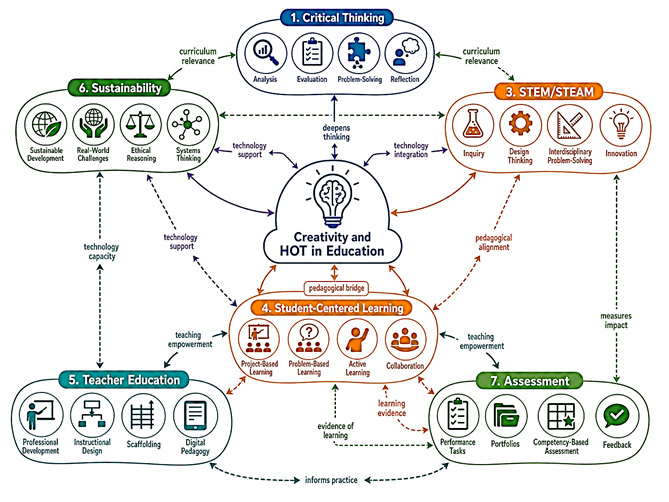
The ability to think critically and creatively is a central goal of 21st-century education. This study uses scientometric and bibliometric analysis to map the development of research on creativity and higher-order thinking (HOT) from 2014 to 2024 within a Scopus-indexed STEM/science and higher education-related dataset. Using Scopus as the primary database, 799 publications were analyzed to identify publication growth, citation impact, influential authors and sources, country-level publication output, collaboration networks, and thematic structures. VOSviewer and Biblioshiny were used to visualize and examine co-authorship networks, citation patterns, and keyword co-occurrence clusters. The findings show a sharp increase in creativity and HOT-related publications, especially after 2020, indicating growing scholarly attention to critical thinking, creative thinking, technology-enhanced learning, STEM/STEAM education, and interdisciplinary pedagogy. The geographic analysis shows that Indonesia, the United States, China, Malaysia, and Taiwan were the most visible contributors in terms of publication output within the analyzed Scopus dataset. However, publication volume should not be interpreted as a complete measure of research leadership without considering citation impact, collaboration quality, policy context, and journal influence. The keyword analysis identified several major themes, including critical thinking in education, digital and technology-supported learning, STEM/STEAM and interdisciplinary learning models, student-centered pedagogy, sustainability-oriented problem-solving, teacher education, and assessment of complex competencies. Overall, the study shows that creativity and HOT research in this dataset has evolved from a primarily cognitive focus toward a broader educational agenda involving curriculum design, digital learning, teacher capacity, sustainability, and competency-based assessment. The findings suggest the need for further studies on AI-supported HOT education, cross-cultural comparisons, teacher professional development, equity in technology-enhanced learning, non-STEM contexts, and longitudinal assessment of HOT skill development.
Adams, D., & Moosa, V. (2024). Leadership, Learning and Teaching Practice in Higher Education: A 2016-2023 Bibliometric Review. Journal of University Teaching and Learning Practice, 21(05). https://doi.org/10.53761/4fd9xn32
Ahmed, S. A. M., Zhang, W., Ma, H., & Feng, Z. (2023). Professional development for STEM educators: A bibliometric analysis of the recent progress. Review of Education, 11(1). Scopus. https://doi.org/10.1002/rev3.3392
Amorim, L. R. P., Santos, C., & Timmis, K. N. (2025). Prioritising Microbiology in Secondary Education Addresses Emerging Scientific‐Social‐Educational Challenges and Competency Needs. Microbial Biotechnology, 18(9). https://doi.org/10.1111/1751-7915.70224
Amrianto, Rohman, F., Dharmawan, A., & Sari, M. S. (2024). Development of a 4C Skills Evaluation Instrument for Biology: A Validity and Reliability Study on Indonesian High School Students Learning. International Journal of Innovative Research and Scientific Studies, 7(2), 701–717. https://doi.org/10.53894/ijirss.v7i2.2873
Anthony, A., & Sharma, S. (2025). Ethics in the Era of ChatGPT: A Bibliometric Analysis of the Transformative Trajectory of Emerging Trends in Artificial Intelligence in Academic Research. Journal of Educational Technology Systems, 54(2), 258–290. https://doi.org/10.1177/00472395251356520
Antonova, O., Myronchuk, N., Pavlenko, V., Kovalchuk, V., & Korniichuk, M. (2024). Modern Technologies and their Impact on Educational Transformations in Preparing a Creative Specialist. Nanotechnology Perceptions, 473–491. https://doi.org/10.62441/nano-ntp.vi.420
Apiola, M., López‐Pernas, S., Saqr, M., Pears, A., Daniels, M., Malmi, L., & Tedre, M. (2022). From a National Meeting to an International Conference: A Scientometric Case Study of a Finnish Computing Education Conference. Ieee Access, 10, 66576–66588. https://doi.org/10.1109/access.2022.3184718
Appiah, K. O., Addai, B., Ekuban, W., Aidoo, S. O., & Amankwah-Amoah, J. (2022). Management research and the impact of COVID-19 on performance: A bibliometric review and suggestions for future research. Future Business Journal, 8(1), 41. https://doi.org/10.1186/s43093-022-00149-1
Aria, M., & Cuccurullo, C. (2017). bibliometrix: An R-tool for comprehensive science mapping analysis. Journal of Informetrics, 11(4), 959–975. https://doi.org/10.1016/j.joi.2017.08.007
Ariyani, Y. D., Wilujeng, İ., & Dwiningrum, S. I. A. (2022). Bibliometric Analysis of SCAMPER Strategy Over the Past 20 Years. International Journal of Evaluation and Research in Education (Ijere), 11(4), 1930. https://doi.org/10.11591/ijere.v11i4.22316
Aryana, S., Zulaeha, I., Pristiwati, R., & Haryadi, H. (2024). Writing Assessment Model: Demands of Indonesian Teachers in the 21st Century. Journal of Language Teaching and Research, 15(3), 763–771. https://doi.org/10.17507/jltr.1503.09
Avello-Sáez, D., & Estrada-Palavecino, L. (2023). ChatGPT Y Su Impacto en La Formación De Competencias en Terapeutas Ocupacionales: Una Reflexión Sobre La Integridad Académica. Cadernos Brasileiros De Terapia Ocupacional, 31. https://doi.org/10.1590/2526-8910.ctoen271035343
Aziz, M., & Rawian, R. M. (2022). Modeling Higher Order Thinking Skills and Metacognitive Awareness in English Reading Comprehension Among University Learners. Frontiers in Education, 7. https://doi.org/10.3389/feduc.2022.991015
Badarnah, L. (2025). Holistic Education for a Resilient Future: An Integrated Biomimetic Approach for Architectural Pedagogy. Biomimetics, 10(6), 369. https://doi.org/10.3390/biomimetics10060369
Bassachs, M., Cañabate, D., Nogué, L., Serra, T., Bubnys, R., & Colomer, J. (2020). Fostering critical reflection in primary education through STEAM approaches. Education Sciences, 10(12), 1–14. Scopus. https://doi.org/10.3390/educsci10120384
Bataineh, R. F., Bataineh, R. F., AlAli, R., Alotaibi, S. B., Al-Barakat, A. A., AL-SAUD, K. M., & Ibrahim, N. A. (2025). Digital Frontiers: The Transformative Potential of E-Learning in Cultivating Arab Primary School Learners’ Creativity. Sage Open, 15(4). https://doi.org/10.1177/21582440251408317
Canal, M. N., Ardavin, A. F., Díaz-Marcos, L., & AGUADO-TEVAR, O. (2024). Aprendizaje Generativo Integral: Un Modelo Para La Educación Superior Ante Los Desafíos De La Inteligencia Artificial. European Public & Social Innovation Review, 9, 1–21. https://doi.org/10.31637/epsir-2024-1685
Castillo-Quiñones, C. S., Serrano-Leyva, B., & Díaz-Pompa, F. (2023). Bibliometric Study About Sustainable Tourism Product in Scopus Database. Revista Interamericana De Ambiente Y Turismo, 19(1), 90–99. https://doi.org/10.4067/s0718-235x2023000100090
Chavda, M., Patel, H., & Bhatt, H. (2023). Quality Education Through Writing: Aligning Learning Objectives in Learning Materials and Question Papers Using Bloom’s Taxonomy. Quality Assurance in Education, 32(1), 96–110. https://doi.org/10.1108/qae-03-2023-0045
Chen, J., Wang, M., Kirschner, P. A., & Tsai, C.-C. (2018). The Role of Collaboration, Computer Use, Learning Environments, and Supporting Strategies in CSCL: A Meta-Analysis. Review of Educational Research, 88(6), 799–843. https://doi.org/10.3102/0034654318791584
Chen, X., Zhang, Y., Guo, J., Wang, Y., Wang, Y., Zhao, Y., Zou, N., Li, S., & Rong, P. (2024). Opportunities and Trends of Transcutaneous Auricular Vagus Nerve Stimulation. Gut Microbiota and Integrative Wellness, 2. https://doi.org/10.54844/gmiw.2024.0519
Cruz, M. L., Saunders-Smits, G. N., & Groen, P. (2020). Evaluation of competency methods in engineering education: A systematic review. European Journal of Engineering Education, 45(5), 729–757. https://doi.org/10.1080/03043797.2019.1671810
Derviş, H. (2020). Bibliometric Analysis using Bibliometrix an R Package. Journal of Scientometric Research, 8(3), 156–160. https://doi.org/10.5530/jscires.8.3.32
Du, X., & Xi, W. (2023). Play by Design: Developing Artificial Intelligence Literacy Through Game-Based Learning. Journal of Computer Science Research, 5(4), 1–12. https://doi.org/10.30564/jcsr.v5i4.5999
Dúo-Terrón, P. (2023). Analysis of Scratch Software in Scientific Production for 20 Years: Programming in Education to Develop Computational Thinking and STEAM Disciplines. Education Sciences, 13(4), 404. https://doi.org/10.3390/educsci13040404
Dúo-Terrón, P., Hinojo-Lucena, F.-J., Moreno-Guerrero, A.-J., & López-Belmonte, J. (2022). Impact of the Pandemic on STEAM Disciplines in the Sixth Grade of Primary Education. European Journal of Investigation in Health, Psychology and Education, 12(8), 989–1005. Scopus. https://doi.org/10.3390/ejihpe12080071
ElSayary, A., Zein, R., & Antonio, L. S. (2022). Using Interactive Technology to Develop Preservice Teachers’ STEAM Competencies in Early Childhood Education Program. Eurasia Journal of Mathematics, Science and Technology Education, 18(2). Scopus. https://doi.org/10.29333/EJMSTE/11649
Fam, S.-F., Lan, X.-E., Wahjono, S. I., & Sahlan, M. K. (2024). Bibliometric Analysis on Technical and Vocational Education and Training (TVET) Research. International Journal of Academic Research in Progressive Education and Development, 13(3). https://doi.org/10.6007/ijarped/v13-i3/22260
Fidan, M., & Tuncel, M. (2019). Integrating augmented reality into problem based learning: The effects on learning achievement and attitude in physics education. Computers & Education, 142, 103635. https://doi.org/10.1016/j.compedu.2019.103635
Fikriyati, A., Agustini, R., & Sutoyo, S. (2022). Critical thinking cycle model to promote critical thinking disposition and critical thinking skills of pre-service science teacher. Cypriot Journal of Educational Sciences, 17(1), 120–133. Scopus. https://doi.org/10.18844/cjes.v17i1.6690
González-Pérez, L. I., & Soledad, M. (2022). Components of Education 4.0 in 21st Century Skills Frameworks: Systematic Review. Sustainability, 14(3), 1493. https://doi.org/10.3390/su14031493
Gozali, I., Syahid, A., & Suryati, N. (2023). Ten Years After Sutton (2012): Quo Vadis Feedback Literacy? (A Bibliometric Study). Register Journal, 16(1), 139–167. https://doi.org/10.18326/register.v16i1.139-167
Gül, M. D., & Ayık, Z. (2024). Comprehensive Science Mapping of STEM Studies in Gifted Education. Journal of Turkish Science Education, 21(1), 153–174. https://doi.org/10.36681/tused.2024.009
Hébert, C., & Jenson, J. (2021). Teaching With Sandbox Games: Minecraft, Game-Based Learning, and 21st Century Competencies. Canadian Journal of Learning and Technology, 46(3). https://doi.org/10.21432/cjlt27990
Henriksen, D., Mishra, P., & Stern, R. E. (2024). Creative Learning for Sustainability in a World of AI: Action, Mindset, Values. Sustainability, 16(11), 4451. https://doi.org/10.3390/su16114451
Hernández-Ramos, J., Pernaa, J., Cáceres-Jensen, L., & Rodríguez-Becerra, J. (2021). The effects of using socio-scientific issues and technology in problem-based learning: A systematic review. Education Sciences, 11(10). Scopus. https://doi.org/10.3390/educsci11100640
Hodson, D. (2014). Nature of Science in the Science Curriculum: Origin, Development, Implications and Shifting Emphases. In M. R. Matthews (Ed.), International Handbook of Research in History, Philosophy and Science Teaching (pp. 911–970). Springer Netherlands. https://doi.org/10.1007/978-94-007-7654-8_28
Huang, B., Jong, M. S.-Y., King, R. B., Chai, C.-S., & Jiang, M. Y.-C. (2022). Promoting Secondary Students’ Twenty-First Century Skills and STEM Career Interests Through a Crossover Program of STEM and Community Service Education. Frontiers in Psychology, 13. Scopus. https://doi.org/10.3389/fpsyg.2022.903252
Hujjatusnaini, N., Corebima, A. D., Prawiro, S. R., & Gofur, A. (2022). The effect of blended project-based learning integrated with 21st-century skills on pre-service biology teachers’ higher-order thinking skills. Jurnal Pendidikan IPA Indonesia, 11(1), 104–118. Scopus. https://doi.org/10.15294/jpii.v11i1.27148
Hwang, Y., & Wu, Y. (2025). The Influence of Generative Artificial Intelligence on Creative Cognition of Design Students: A Chain Mediation Model of Self-Efficacy and Anxiety. Frontiers in Psychology, 15. https://doi.org/10.3389/fpsyg.2024.1455015
Ibrahim, S. F., Jamiat, N., Rabu, S. N. A., & Hassan, N. (2024). Examining the Trend of Creative Thinking as an Essential Key for 21st Century: A Bibliometric Mapping. Environment-Behaviour Proceedings Journal, 9(SI17), 65–74. https://doi.org/10.21834/e-bpj.v9isi17.5420
Jantakoon, T., Jantakun, T., & Jantakun, K. (2024). A Scientometrics Analysis and Systematic Review of STEAM Education With Gamification. Asian Journal of Education and Training, 10(2), 89–103. https://doi.org/10.20448/edu.v10i2.5618
Jia, X.-H., & Tu, J.-C. (2024). Towards a New Conceptual Model of AI-Enhanced Learning for College Students: The Roles of Artificial Intelligence Capabilities, General Self-Efficacy, Learning Motivation, and Critical Thinking Awareness. Systems, 12(3). Scopus. https://doi.org/10.3390/systems12030074
Kalogiannakis, M., Papadakis, S., & Zourmpakis, A.-I. (2021). Gamification in science education. A systematic review of the literature. Education Sciences, 11(1), 1–36. Scopus. https://doi.org/10.3390/educsci11010022
Kamarrudin, H. ’., Talib, O., Kamarudin, N., Ismail, N., & Zamin, A. A. M. (2022). Examining the Trend of Research on Active Engagement in Science Education: Bibliometric Analysis. Journal of Turkish Science Education, 19(3), 937–957. https://doi.org/10.36681/tused.2022.157
Karaköse, T., Leithwood, K., & Tülübaş, T. (2024). The Intellectual Evolution of Educational Leadership Research: A Combined Bibliometric and Thematic Analysis Using SciMAT. Education Sciences, 14(4), 429. https://doi.org/10.3390/educsci14040429
Kaur, M., & Saini, M. (2024). Role of Artificial Intelligence in the Crime Prediction and Pattern Analysis Studies Published Over the Last Decade: A Scientometric Analysis. Artificial Intelligence Review, 57(8). https://doi.org/10.1007/s10462-024-10823-1
Kaymakci, G., & Can, Ş. (2023). Bibliometric Analysis of the Articles on STEM/STEAM Education in Gifted Students. International Journal of Turkish Education Sciences, 2023(21), 275–308. https://doi.org/10.46778/goputeb.1258457
Kizilay, E., Saylan Kirmizigül, A., & Çevik, M. (2023). The Impact of Technology-Supported Interdisciplinary Integration on Critical Thinking and Creativity: The Perspective of Pre-Service Teachers. Participatory Educational Research, 10(3), 247–265. Scopus. https://doi.org/10.17275/per.23.54.10.3
Korkmaz, G., & Toraman, Ç. (2024). Reflective Thinking: A Bibliometric Analysis of Four Decades of Research and Insights for Future Studies. International Journal of Education in Mathematics Science and Technology, 12(4), 1053–1070. https://doi.org/10.46328/ijemst.4231
Kurniawan, A., Tantri, I. D., & Fian, K. (2023). Effectiveness of STEM-Based Lectora Inspire Media to Improve Students’ HOTS in Physics Learning. Jurnal Penelitian & Pengembangan Pendidikan Fisika, 9(1), 55–66. https://doi.org/10.21009/1.09106
Lee, H.-Y. (2023). Integrating Computational Thinking Into Scaffolding Learning: An Innovative Approach to Enhance Science, Technology, Engineering, and Mathematics Hands-on Learning. Journal of Educational Computing Research, 62(2), 431–467. https://doi.org/10.1177/07356331231211916
Lee, H.-Y., Chen, P.-H., Wang, W.-S., Huang, Y.-M., & Wu, T.-T. (2024). Empowering ChatGPT with guidance mechanism in blended learning: Effect of self-regulated learning, higher-order thinking skills, and knowledge construction. International Journal of Educational Technology in Higher Education, 21(1). Scopus. https://doi.org/10.1186/s41239-024-00447-4
Li, J., Luo, H., Zhao, L., Zhu, M., Ma, L., & Liao, X. (2022). Promoting STEAM Education in Primary School through Cooperative Teaching: A Design-Based Research Study. Sustainability (Switzerland), 14(16). Scopus. https://doi.org/10.3390/su141610333
Li, Y., & Talib, C. A. (2024). Developing a Knowledge Map for the Early Childhood Steam Education: A Visual Analysis Using citespace and Histcite. Journal of Baltic Science Education, 23(1), 56–75. https://doi.org/10.33225/jbse/24.23.56
Li, Y., Zhang, X., Dai, D. Y., & Hu, W. (2021). Curriculum Innovation in Times of the COVID-19 Pandemic: The Thinking-Based Instruction Theory and Its Application. Frontiers in Psychology, 12. Scopus. https://doi.org/10.3389/fpsyg.2021.601607
Lin, G. S. S., Sim, A. Y. Y., Sana, E. A., & Johnson, G. U. (2025). Charting the Use of Mini-Clinical Evaluation Exercise (Mini-Cex) in Nursing and Dental Education: A Bibliometric Analysis From the Web of Science Database. Journal of Yeungnam Medical Science, 42, 43. https://doi.org/10.12701/jyms.2025.42.43
Liu, X., Wang, X., Xu, K., & Hu, X. (2023). Effect of Reverse Engineering Pedagogy on Primary School Students’ Computational Thinking Skills in STEM Learning Activities. Journal of Intelligence, 11(2). Scopus. https://doi.org/10.3390/jintelligence11020036
Lu, K., Pang, F., & Shadiev, R. (2023). How to deepen college students’ approach to using technologies in T‐O‐IBL? Examining the mediating influence of deep approaches to using technologies between learning factors and higher order thinking skills. Journal of Computer Assisted Learning, 39(1), 182–193. https://doi.org/10.1111/jcal.12738
Luchang, A. L., & Nasri, N. B. M. (2023). Project-Based Learning (Pbl) in Enhancing Students’ Higher-Order Thinking Skills (Hots): Systematic Literature Review. International Journal of Academic Research in Progressive Education and Development, 12(4). https://doi.org/10.6007/ijarped/v12-i4/20404
Lysak, V. (2024). A Theoretical Analysis of Philosophical Dimensions in Engineering Education. Journal of Contemporary Philosophical and Anthropological Studies, 2(3). https://doi.org/10.59652/jcpas.v2i3.307
Mahmudati, R. (2023). The Characteristics and Developing an Assessment Instrument of High Order Thinking Skill (Hots) Items With 4-D Models. Jurnal Pendidikan Matematika Dan Ipa, 14(1), 107. https://doi.org/10.26418/jpmipa.v14i1.55497
Maker, C. J., Pease, R., & Zimmerman, R. H. (2023). Developing Scientific, Transformational, Eloquent, Artistic, Mathematical, Mechanical, Emotional, Relational, and Social Talents Through Problem Solving: A Conceptual, Practical, Evidence-Based Analysis. Gifted Education International, 39(2), 104–128. https://doi.org/10.1177/02614294231153519
Markula, A., & Aksela, M. (2022). The key characteristics of project-based learning: How teachers implement projects in K-12 science education. Disciplinary and Interdisciplinary Science Education Research, 4(1). Scopus. https://doi.org/10.1186/s43031-021-00042-x
Martawijaya, M. A., Rahmadhanningsih, S., Swandi, A., Hasyim, M., & Sujiono, E. H. (2023). The Effect of Applying the Ethno-Stem-Project-Based Learning Model on Students’ Higher-Order Thinking Skill and Misconception of Physics Topics Related to Lake Tempe, Indonesia. Jurnal Pendidikan Ipa Indonesia, 12(1), 1–13. https://doi.org/10.15294/jpii.v12i1.38703
Misri, M. A., Saifuddin, S., Akbar, R. O., & Kamelia, N. R. (2021). Development and Evaluation of a HOTS-based Test for Matrix Topic: A Classical Test and Item Response Theory. Beta Jurnal Tadris Matematika, 14(2). https://doi.org/10.20414/betajtm.v14i2.383
Moreno-Pino, F. M., Jiménez-Fontana, R., Domingo, J. M. C., & María del Pilar Azcárate Goded. (2021). Study of the Presence of Sustainability Competencies in Teacher Training in Mathematics Education. Sustainability, 13(10), 5629. https://doi.org/10.3390/su13105629
Mukhlis, M., Suwandi, S., Rohmadi, M., & Setiawan, B. (2023). Higher Order Thinking Skills in Reading Literacy Questions at Vocational High Schools in Indonesia. International Journal of Language Education, 7(4). https://doi.org/10.26858/ijole.v7i4.37603
Mukhtar, S., & Razak, A. Z. A. (2024). Examining the Trends, Themes and Social Structure of Teacher Leadership Literature: A Bibliometric Review. Malaysian Journal of Social Sciences and Humanities (Mjssh), 9(6), e002880. https://doi.org/10.47405/mjssh.v9i6.2880
National Academies of Sciences, Engineering, and Medicine. (2018). How People Learn II: Learners, Contexts, and Cultures (p. 24783). National Academies Press. https://doi.org/10.17226/24783
Ng, K. T., Thah, S. S., & Parahakaran, S. (2023). Fostering Thinking Skills Supported by E-Portals With Case Examples of Blended Mode Problem-Based Learning (PBL) Participated by Secondary School Learners. International Journal on E-Learning Practices (Ijelp). https://doi.org/10.51200/ijelp.v1i1.183
Norliza, M. Y., Luqman, S. M., Zulqarnain, M. N. M., & Mohd Salimi Mohd Nur Fitri. (2024). Mapping the Landscape of E-Learning Research: A Bibliometric Analysis. International Journal on E-Learning and Higher Education, 19(1), 23–42. https://doi.org/10.24191/ijelhe.v19n1.1912
Nunvarova, J., Poulova, P., Prazak, P., & Klimova, B. (2023). Effectiveness of Digital Storytelling in Teaching Economics. Education Sciences, 13(5). Scopus. https://doi.org/10.3390/educsci13050504
Nwankwo, C. O., Mahachi, J., Olukanni, D. O., & Musonda, I. (2024). Africa’s Natural Fibres Used in Polymer Composites: A Systematic Review. Polymer Composites, 45(11), 9677–9702. https://doi.org/10.1002/pc.28482
Obnial, J. C., Escuadra, C. J. T., Miranda, A. V., & Lucero-Prisno, D. E. E. (2024). Infectious Disease Research in the Association of Southeast Asian Nations Region: A Scientometric Analysis. Osong Public Health and Research Perspectives, 15(4), 329–339. https://doi.org/10.24171/j.phrp.2024.0058
Oyewo, O., Ramaila, S., & Mavuru, L. (2022). Harnessing Project-Based Learning to Enhance STEM Students’ Critical Thinking Skills Using Water Treatment Activity. EDUCATION SCIENCES, 12(11). (WOS:000883867900001). https://doi.org/10.3390/educsci12110780
Pimdee, P. (2022). Thai Undergraduate Science, Technology, Engineering, Arts, and Math (STEAM) Creative Thinking and Innovation Skill Development: A Conceptual Model Using a Digital Virtual Classroom Learning Environment. Education and Information Technologies, 27(4), 5689–5716. https://doi.org/10.1007/s10639-021-10849-w
Prahani, B. K., Dawana, I. R., Jatmiko, B., & Amelia, T. (2023). Research Trend of Big Data in Education During the Last 10 Years. International Journal of Emerging Technologies in Learning, 18(10), 39–64. Scopus. https://doi.org/10.3991/ijet.v18i10.38453
Prahani, B. K., Nisa, K., Nurdiana, M. A., Kurnianingsih, E., Amiruddin, M. Z. B., & Sya’roni, I. (2023). Analyze of STEAM Education Research for Three Decades. Journal of Technology and Science Education, 13(3), 837. https://doi.org/10.3926/jotse.1670
Psycharis, S., & Kallia, M. (2017). The effects of computer programming on high school students’ reasoning skills and mathematical self-efficacy and problem solving. Instructional Science, 45(5), 583–602. https://doi.org/10.1007/s11251-017-9421-5
Purwaningsih, E., Sari, S. P., Sari, A. M., & Suryadi, A. (2020). The effect of stem-pjbl and discovery learning on improving students’ problem-solving skills of the impulse and momentum topic. Jurnal Pendidikan IPA Indonesia, 9(4), 465–476. Scopus. https://doi.org/10.15294/jpii.v9i4.26432
Putri, A. S., Prasetyo, Z. K., Purwastuti, L. A., Prodjosantoso, A. K., & Putranta, H. (2023). Effectiveness of STEAM-based blended learning on students’ critical and creative thinking skills. International Journal of Evaluation and Research in Education, 12(1), 44–52. Scopus. https://doi.org/10.11591/ijere.v12i1.22506
Quigley, C. F., Herro, D., & Jamil, F. M. (2017). Developing a Conceptual Model of STEAM Teaching Practices. School Science and Mathematics, 117(1–2), 1–12. https://doi.org/10.1111/ssm.12201
Rabbani, M. R., Hassan, M. K., Dejan, A., Bashar, A., & Hasan, Md. B. (2024). A Bibliometric Analysis of the Review Papers in Finance: Evidence From the Last Two Decades. Review of Financial Economics, 42(3), 241–257. https://doi.org/10.1002/rfe.1197
Razak, A., Santosa, T. A., Lufri, L., & Irdawati, I. (2022). The Influence of the Science Technology Engineering and Mathematics Approach With Mind Maps on the Higher Order Thinking Skills (HOTS) of Students in Biology Learning Class X SMA N 4 Kerinci. International Journal of Education and Literature, 1(2), 77–82. https://doi.org/10.55606/ijel.v1i2.34
Rehman, N., Zhang, W., Mahmood, A., Fareed, M. Z., & Batool, S. (2023). Fostering twenty-first century skills among primary school students through math project-based learning. Humanities and Social Sciences Communications, 10(1). Scopus. https://doi.org/10.1057/s41599-023-01914-5
Rosário, A. T., & Raimundo, R. (2024). Sustainable Entrepreneurship Education: A Systematic Bibliometric Literature Review. Sustainability, 16(2), 784. https://doi.org/10.3390/su16020784
Roveri, V., Correia, A. T., Toma, W., Rodrigues, A. Z., Pereira, C. D. S., & Guimarães, L. L. (2025). A Scientometric Dataset on Pharmaceuticals and Illicit Drugs (Including Cocaine) in the Water Resources of Latin America and the Caribbean (1990–2024). Data in Brief, 63, 112100. https://doi.org/10.1016/j.dib.2025.112100
Saefudin, A. A., Wijaya, A., & Dwiningrum, S. I. A. (2023). Mapping Research Trends in Mathematical Creativity in Mathematical Instructional Practices: A Bibliometric Analysis. Journal of Pedagogical Research. https://doi.org/10.33902/jpr.202322691
Sallam, M., Mohammadi, M., Sainsbury, F., Nguyen, N., Kimizuka, N., Muyldermans, S., & Benešová-Schäfer, M. (2024). Bibliometric and Scientometric Analysis of PSMA-targeted Radiotheranostics: Knowledge Mapping and Global Standing. Frontiers in Oncology, 14. https://doi.org/10.3389/fonc.2024.1397790
Samad, N. A., Osman, K., & Nayan, N. A. (2023). Learning chemistry through designing and its effectiveness towards inventive thinking. Eurasia Journal of Mathematics, Science and Technology Education, 19(12). Scopus. https://doi.org/10.29333/ejmste/13883
Sandoval, M. T. R. (2021). Design and Validation of an Instrument to Assess a Didactic Sequence Directed to Promote the Development of Critical Thinking. Turkish Journal of Computer and Mathematics Education (Turcomat), 12(4), 300–309. https://doi.org/10.17762/turcomat.v12i4.508
Sasson, I., Yehuda, I., Miedijensky, S., & Malkinson, N. (2021). Designing New Learning Environments: An Innovative Pedagogical Perspective. The Curriculum Journal, 33(1), 61–81. https://doi.org/10.1002/curj.125
Şeker, F. (2025). STEM for Quality Education: Thematic and Bibliometric Trends (1993–2024). British Educational Research Journal. https://doi.org/10.1002/berj.70009
Shahril, M. I., Guntur, G., Yin, T. T., & Mustafa, L. M. (2023). Alternative Pedagogy Approaches in Physical Education and Health Education. Journal of Higher Education Theory and Practice, 23(6). https://doi.org/10.33423/jhetp.v23i6.5960
Shomoossi, N., Fiezabadi, M., Vaziri, E., Shabani, E. A., & Amiri, M. (2023). International Aspects in Healthcare and Medical Education: Scientometric Trends and Knowledge Maps Before the COVID-19 Pandemic. Journal of Education and Health Promotion, 12(1). https://doi.org/10.4103/jehp.jehp_53_23
Shou, X., Han, K., & Sheng-quan, L. (2025). Primary Students’ Core Dimension of Higher Order Thinking in Science: Measurement and Reflections. Psychology in the Schools, 62(11), 4760–4778. https://doi.org/10.1002/pits.70035
Siew, N. M., & Basari, J. (2024). The Integration of Problem-Based and Collaborative Learning Assisted by Geometer’s Sketch Pad: Its Effects on Students’ Higher-Order Thinking Skills and Collaborative Skills. Problems of Education in the 21st Century, 82(2), 275–293. https://doi.org/10.33225/pec/24.82.275
Silva, R., Inácio, H., & Marques, R. P. (2022). Blockchain Implications for Auditing: A Systematic Literature Review and Bibliometric Analysis. Ijdar, 163–192. https://doi.org/10.4192/1577-8517-v22_6
Strelan, P., Osborn, A., & Palmer, E. (2020). The flipped classroom: A meta-analysis of effects on student performance across disciplines and education levels. Educational Research Review, 30, 100314. https://doi.org/10.1016/j.edurev.2020.100314
Sukmojati, E., Viana, S. A., Djami, M. K., Fauzi, A., Syafirah, D., & Bana, E. O. (2025). Critical Thinking in English Language Teaching: A Bibliometric Analysis. F1000research, 14, 1305. https://doi.org/10.12688/f1000research.171160.1
Suprapto, N., Rizki, I. A., & Cheng, T.-H. (2024). Profile of Students’ Physics Critical Thinking Skills and Prospect Analysis of Project-Oriented Problem-Based Learning Model. Journal of Educational and Social Research, 14(3), 134. https://doi.org/10.36941/jesr-2024-0062
Thi, K. N., Duc, H. T., Giao, X. T. T., Thi, N. V., Tuong, V. H. K., Nhu, U. D. T., & Thi, A. L. (2024). STEM Education in Primary Schools of Southeast Asian Countries: An Analysis of Scientific Publications in the Scopus Database From 2000 to 2022. Eurasia Journal of Mathematics Science and Technology Education, 20(4), em2433. https://doi.org/10.29333/ejmste/14432
Thornhill-Miller, B., Camarda, A., Mercier, M., Burkhardt, J.-M., Morisseau, T., Bourgeois-Bougrine, S., Vinchon, F., El Hayek, S., Augereau-Landais, M., Mourey, F., Feybesse, C., Sundquist, D., & Lubart, T. (2023). Creativity, Critical Thinking, Communication, and Collaboration: Assessment, Certification, and Promotion of 21st Century Skills for the Future of Work and Education. Journal of Intelligence, 11(3). Scopus. https://doi.org/10.3390/jintelligence11030054
Tomaszewski, R. (2023). Visibility, Impact, and Applications of Bibliometric Software Tools Through Citation Analysis. Scientometrics, 128(7), 4007–4028. https://doi.org/10.1007/s11192-023-04725-2
Tran, V., Dương, T. T. L., Phan, T. S., Huynh, T., Nguyen, T. H., & Nguyen, T.-L. (2024). ≪span>Researching STEAM in Early Childhood Education Between 2013-2023: A Bibliometric Analysis of Scopus Database. Dong Thap University Journal of Science, 13(7), 18–27. https://doi.org/10.52714/dthu.13.7.2024.1334
Van Eck, N. J., & Waltman, L. (2010). Software survey: VOSviewer, a computer program for bibliometric mapping. Scientometrics, 84(2), 523–538. https://doi.org/10.1007/s11192-009-0146-3
Vásquez, G. C., Pareja, E. M. D., & Tudela, J. M. O. (2023). Diseño Didáctico De Aprendizaje Basado en La Web Para Entrenamiento Docente en Incorporación De Tecnología a La Clase De Inglés. Praxis, 19(2), 287–305. https://doi.org/10.21676/23897856.4979
Vodă, A. I., Căutişanu, C., Grădinaru, C., Tănăsescu, C., & Gustavo Hermínio Salati Marcondes de Moraes. (2022). Exploring Digital Literacy Skills in Social Sciences and Humanities Students. Sustainability, 14(5), 2483. https://doi.org/10.3390/su14052483
Wang, Y., & Gao, X. (2025). The Impact of Augmented Reality Technology on Students’ Innovation Ability: Evidence From a Meta‐analysis. British Journal of Educational Technology, 57(1), 9–32. https://doi.org/10.1111/bjet.13616
Wasak, M. R. P. (2024). Bibliometric Study of Analytical Thinking Skills in Physical Education From Scopus Database. International Journal of Disabilities Sports & Health Sciences, 7(2), 482–493. https://doi.org/10.33438/ijdshs.1373196
Wu, H., Tong, L., Wang, Y., Yan, H., & Sun, Z. (2021). Bibliometric Analysis of Global Research Trends on Ultrasound Microbubble: A Quickly Developing Field. Frontiers in Pharmacology, 12. https://doi.org/10.3389/fphar.2021.646626
Wu, T., Lee, H., Chen, P., Lin, C., & Huang, Y. (2025). Integrating peer assessment cycle into ChatGPT for STEM education: A randomised controlled trial on knowledge, skills, and attitudes enhancement. JOURNAL OF COMPUTER ASSISTED LEARNING, 41(1). (WOS:001341017400001). https://doi.org/10.1111/jcal.13085
Wu, T., Sarwono, E., & Huang, Y. (2025). Incorporating Computational Thinking Into Virtual Laboratories to Enhance Learning Motivation, Engagement, and Higher‐Order Thinking Skills. Journal of Computer Assisted Learning, 41(2). https://doi.org/10.1111/jcal.70017
Yang, D., Wu, X., Liu, J., & Zhou, J. (2023). CiteSpace-based Global Science, Technology, Engineering, and Mathematics Education Knowledge Mapping Analysis. Frontiers in Psychology, 13. https://doi.org/10.3389/fpsyg.2022.1094959
Yıldız, M., Gürel, D. K., Salmankurt, B., & Gürel, H. H. (2024). Exploring the Evolution of Nanotechnology Education: Insights From Bibliometric Analysis. Journal of Chemical Education, 102(1), 253–269. https://doi.org/10.1021/acs.jchemed.4c01120
Zhai, X., & Razali, A. B. (2023). Triple Method Approach to Development of a Genre-Based Approach to Teaching ESL/EFL Writing: A Systematic Literature Review by Bibliometric, Content, and Scientometric Analyses. Sage Open, 13(1). https://doi.org/10.1177/21582440221147255
Zhang, Y., Tian, H., & Lu, J. (2025). The Relationship Between Higher-Order Thinking and Problem-Solving Skills Development Among Pre-Service Teachers Using Generative AI: An Analysis Based on Moderated Mediation. BMC Psychology, 13(1). https://doi.org/10.1186/s40359-025-03404-6
Zhao, Y., Sun, Z., Jiang, Q., & Li, G. (2025). Does Generative Artificial Intelligence Improve Students’ Higher-Order Thinking? A Meta-Analysis Based on 29 Experiments and Quasi-Experiments. Journal of Intelligence, 13(12), 160. https://doi.org/10.3390/jintelligence13120160
Zhou, M. Y. (2024). Students’ Cognition of Art Education and Its Impact on Personal Growth in Selected Schools of China: Towards Integrating Critical Thinking Into Artistic Practices. Pacific International Journal, 7(2). https://doi.org/10.55014/pij.v7i2.562
Zhu, X., & Tahir, S. (2023). A Study of Differences in Higher-Order Thinking Skills Among Higher Education in Blended Learning. International Journal of Academic Research in Progressive Education and Development, 12(4). https://doi.org/10.6007/ijarped/v12-i4/19886
Copyright (c) 2026 Sergii Sharov, Saiful Prayogi, Celci Werner de Rosa

This work is licensed under a Creative Commons Attribution-ShareAlike 4.0 International License.
Authors who publish with Review Journal of Higher-Order Thinking and Metacognition agree to the following terms:
- For all articles published in Review Journal of Higher-Order Thinking and Metacognition, copyright is retained by the authors. The authors grant the publisher permission to announce the work under specific conditions. When the manuscript is accepted for publication, the authors agree to implement a non-exclusive transfer of publishing rights to the journals.
- Authors retain copyright and grant the journal right of first publication with the work simultaneously licensed under a Creative Commons Attribution-ShareAlike 4.0 International License that allows others to share the work with an acknowledgment of the work's authorship and initial publication in this journal.
- Authors are able to enter into separate, additional contractual arrangements for the non-exclusive distribution of the journal's published version of the work (e.g., post it to an institutional repository or publish it in a book), with an acknowledgment of its initial publication in this journal.
- Authors are permitted and encouraged to post their work online (e.g., in institutional repositories or on their website) prior to and during the submission process, as it can lead to productive exchanges, as well as earlier and greater citation of published work (See The Effect of Open Access).

This work is licensed under a Creative Commons Attribution-ShareAlike 4.0 International License.